Negotiation started after the leverage was gone
In a typical enterprise sourcing flow, the buyer runs an RFx event to evaluate suppliers on pricing, capability, and delivery. The winning supplier gets awarded. Only then does the contract go out, and only then does legal discover the supplier wants to rewrite half the terms.
This created four cascading problems:
Extended cycle time
Sending contracts post-award delayed finalization and extended the overall sourcing cycle by weeks.
Lost negotiation leverage
Commercial leverage drops significantly once a supplier is awarded before contract alignment.
Heavy legal dependency
Manual legal reviews created bottlenecks. Every redline required back-and-forth between legal, procurement, and the supplier.
Invisible contract risk
Supplier selection excluded structured contract review, exposing the organization to avoidable risk.
Three modules, one connected flow
The PM approached me with a clear business objective: enable simultaneous RFx and contract issuance with early redlining and AI-powered evaluation. Projects, RFx, and Contracts already shared data through the existing flip mechanism, but contract terms were never part of that handoff. The challenge was extending an existing cross-module flow to carry redlining and risk data all the way from sourcing to contract, without it feeling bolted on.
Mapping the current flow
I started by mapping how sourcing and contracting worked independently. The disconnect was structural: the RFx module had no awareness of contract terms, and the Contracts module had no visibility into sourcing decisions. Two teams, two workflows, zero shared context.
Designing the integrated flow
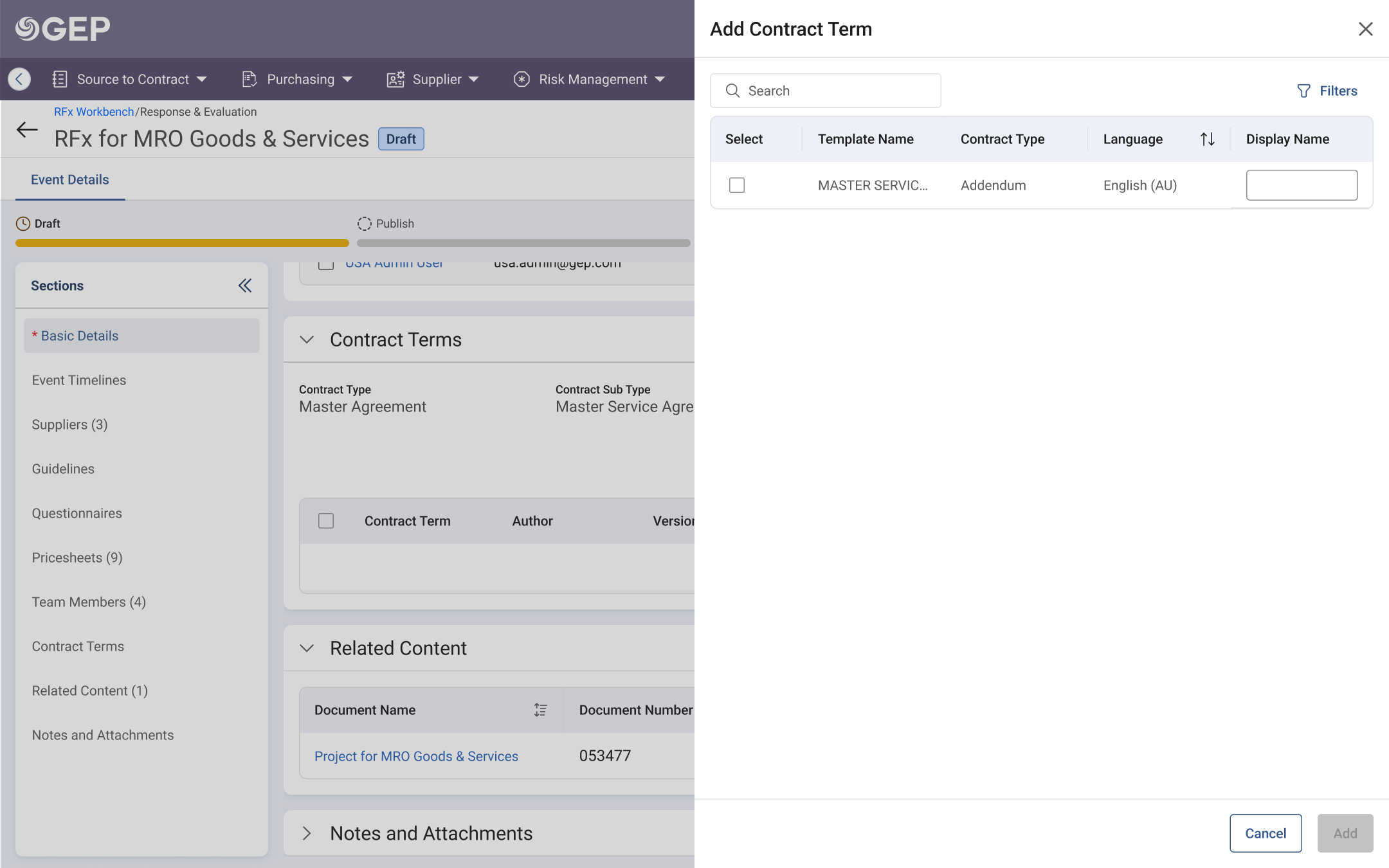
The core design decision: embed a Contract Terms section directly inside the RFx event. The buyer selects standard language templates from the organization's repository, optionally edits them, and publishes. When the RFx goes out, every invited supplier receives a copy of the terms alongside the bid requirements.
The supplier's side
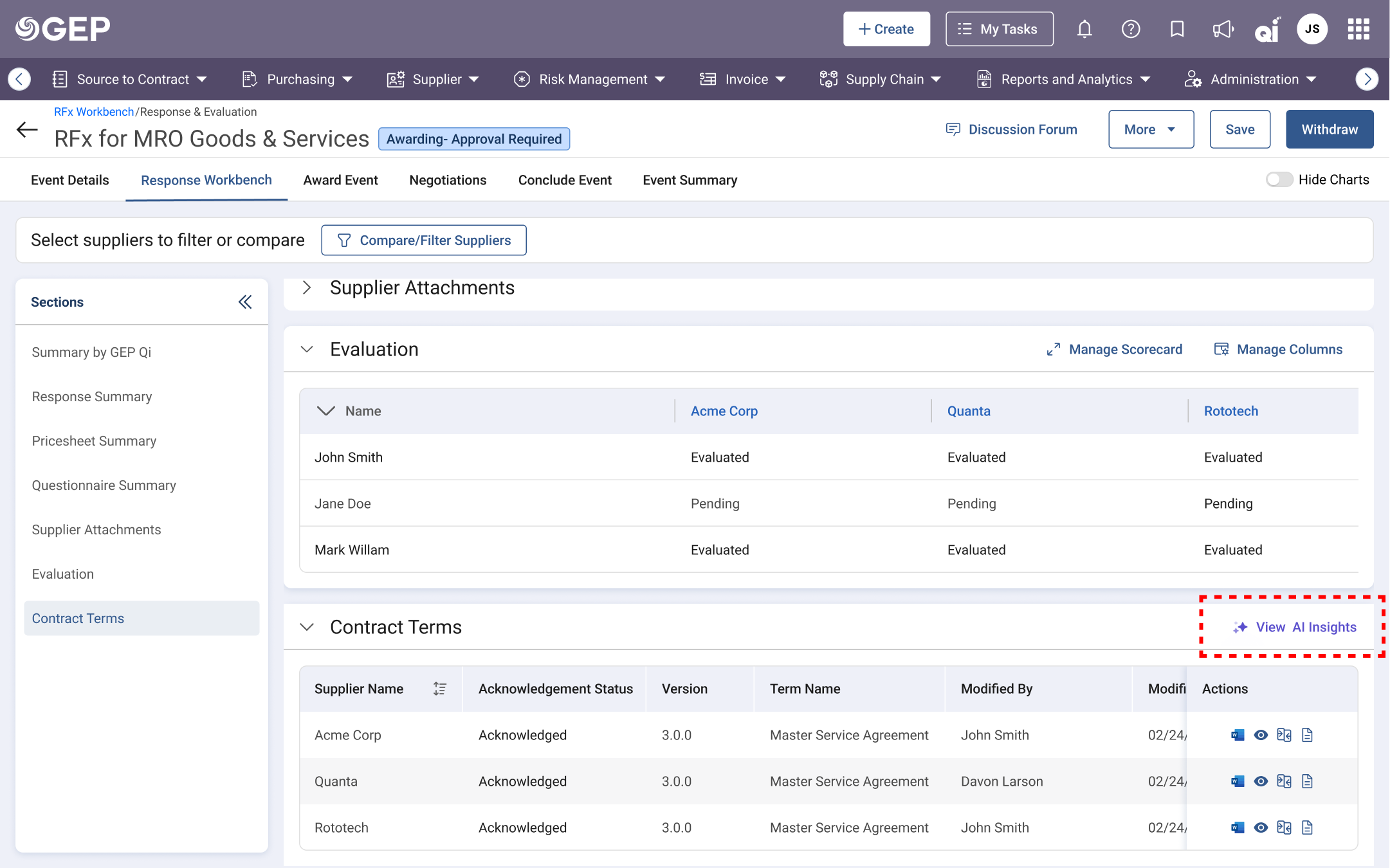
Suppliers see the Contract Terms section in their response view. During the response timeline, they can open the online editor to redline the terms, with tracked changes and versioning. Before submitting their bid, a hard validation requires them to acknowledge the contract terms. No submit without acknowledgment.
The AI layer
Once responses come in, the buyer sees each supplier's acknowledgment status, redline version, and term name in the Response Workbench. This is where the "View AI Insights" button lives. Clicking it triggers the Agentic Redlining Agent to evaluate every deviation against the organization's standard terms and legal playbook.
Designing the AI comparison view
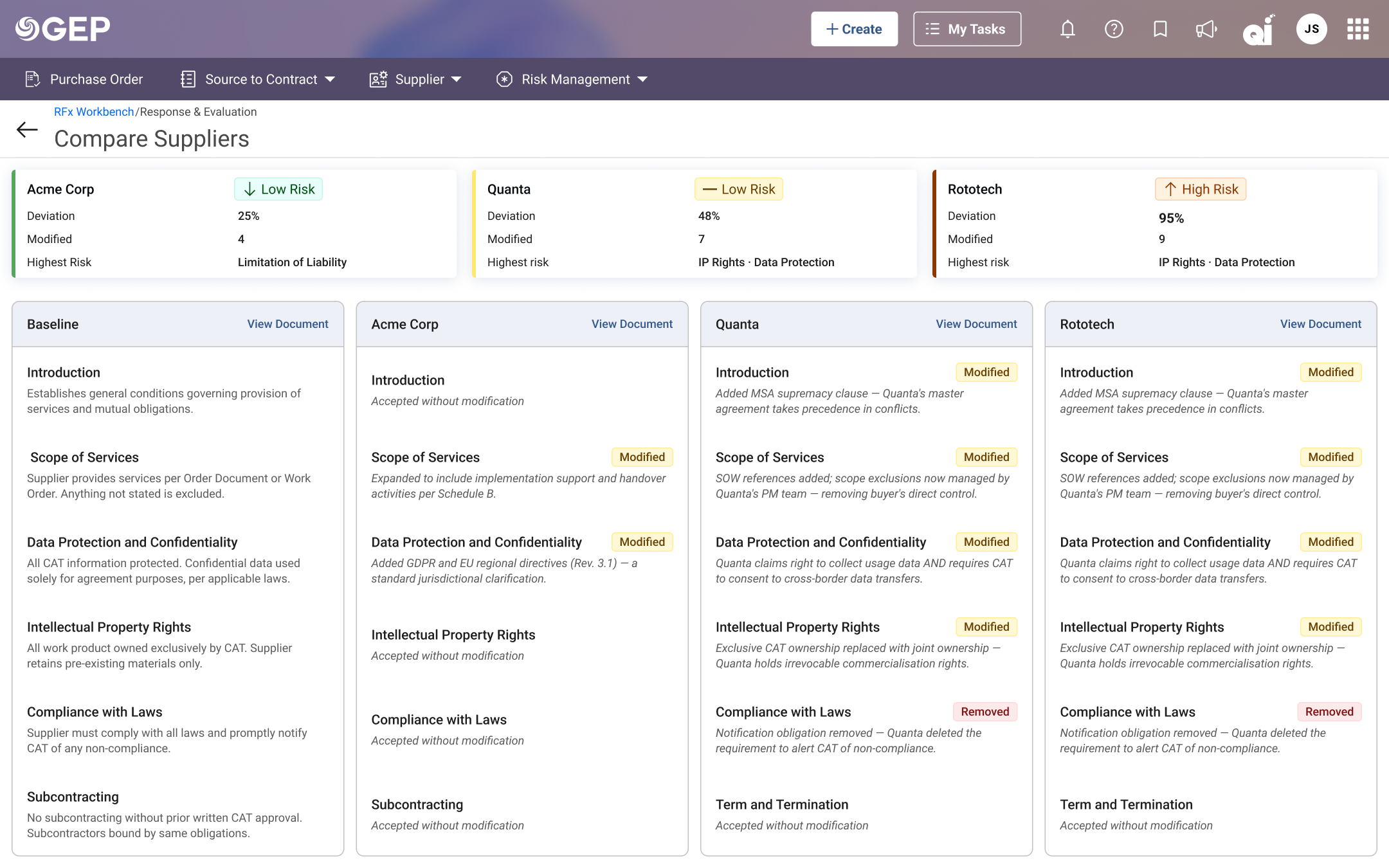
The AI Insights view was the most critical design surface. It needed to show: which clauses each supplier deviated from, the severity of each deviation, a plain-language summary of what changed, and a side-by-side comparison against the original template. This had to be scannable, since a sourcing manager evaluating 5 suppliers shouldn't need to read legal documents.
Risk visible before the handshake
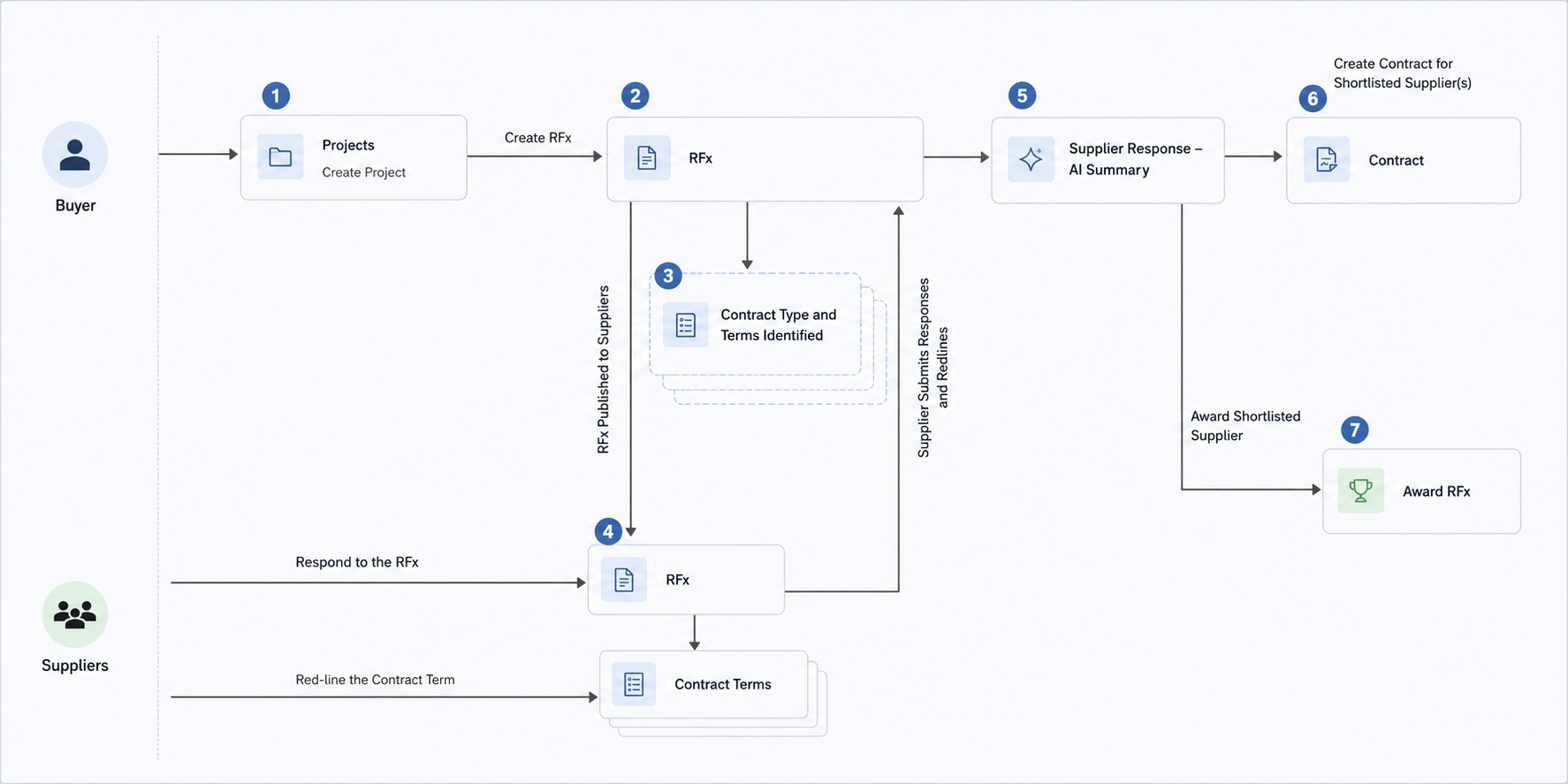
The final design connected three modules into one decision flow:
During RFx creation, the buyer attaches standard contract templates filtered by contract type. These go out with the bid. Suppliers redline terms in an online editor, creating versioned copies. A hard validation gate ensures every supplier has at least opened and acknowledged the terms before submitting.
On the evaluation side, the buyer now has a new dimension alongside pricing and capability: contracting qualitative summary. The AI agent compares each supplier's redlines against the organization's playbook and flags high-risk deviations, generating plain-language summaries, so the award decision factors in contract risk, not just cost.
When the supplier is awarded and the RFx flips to a Contract, all term versions (original, redlined, acknowledged) carry over. No re-uploading. No lost context. The contract module inherits the full negotiation history from sourcing.
What I carried forward
This project changed how I think about design scope. The hardest part wasn't any single screen. It was holding three modules in my head simultaneously and designing transitions between them that felt invisible to the user. The AI layer added another dimension: designing for trust. A sourcing manager won't change their award decision based on an AI summary they don't understand. Every insight had to be traceable back to a specific clause, a specific deviation, a specific risk, not a black-box score. Cross-module design isn't about making things connect. It's about making the connections disappear.