Three fields, five levels, zero visibility
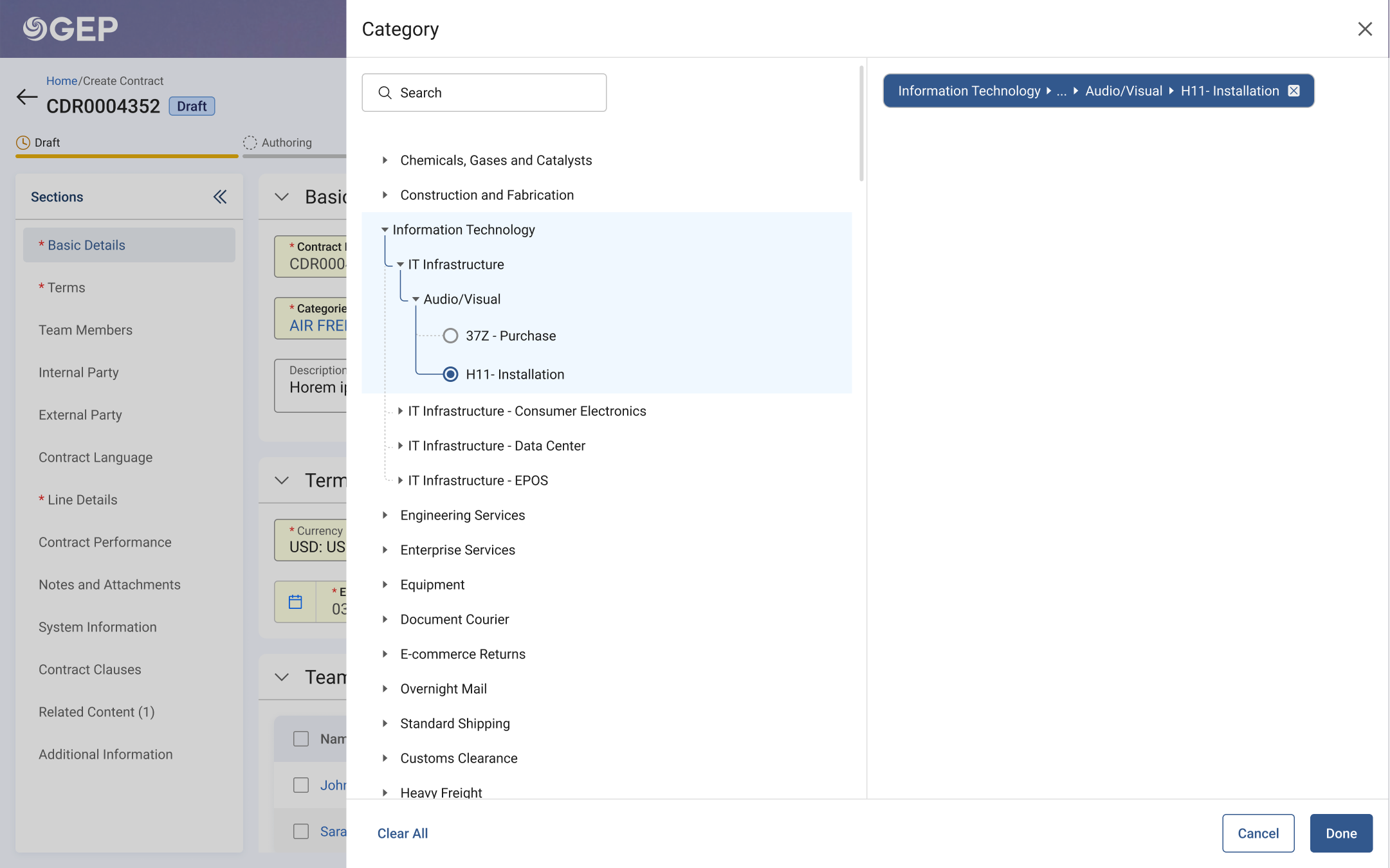
These three fields show up everywhere: contracts, purchase orders, invoices, every document in the platform. They look like simple dropdowns. But "Category" alone can go five levels deep: Information Technology → IT Infrastructure → Audio/Visual → Purchase → H11-Installation. The interface showed none of this. You'd pick something, see a single label, and have no idea where it actually sat in the tree.
Hidden hierarchy
Five levels of taxonomy, flattened into a single list with no parent-child context.
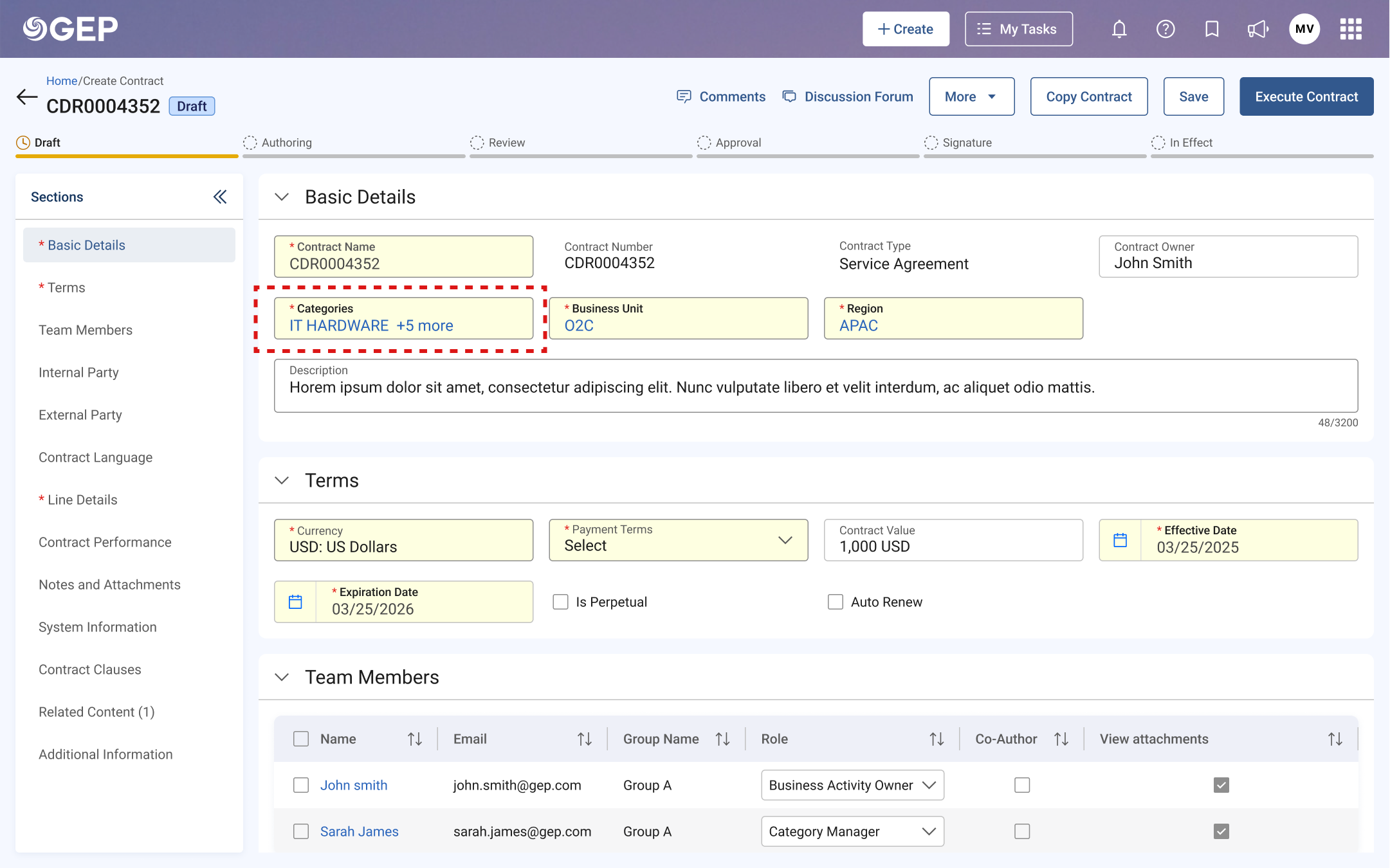
Ghost selections
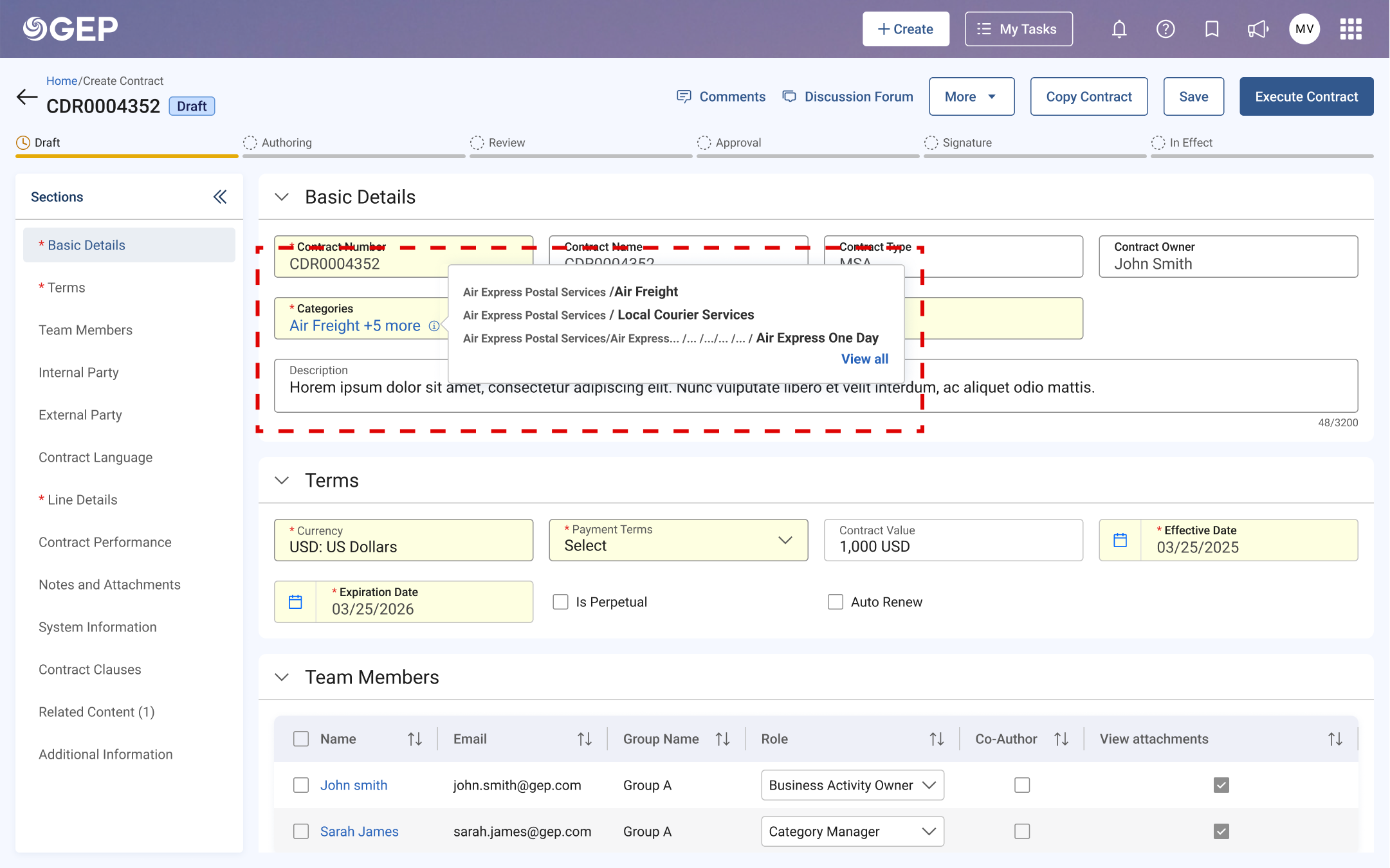
A "+5 more" chip with no way to see, edit, or confirm what was selected.
Disabled radio buttons
Parent nodes had radio buttons that didn't work. No explanation why.
Weak search
Results without context. Same label across branches, no way to tell which.
Two directions, twelve users, two rounds
I began by auditing the existing component across every module it appeared in: Contracts, P2P, Sourcing, mapping where the same CBR (Category, Business Unit, Region) fields surfaced and how differently each module's users interacted with them. The problem wasn't just visual; it was structural.
Exploration: Two prototypes
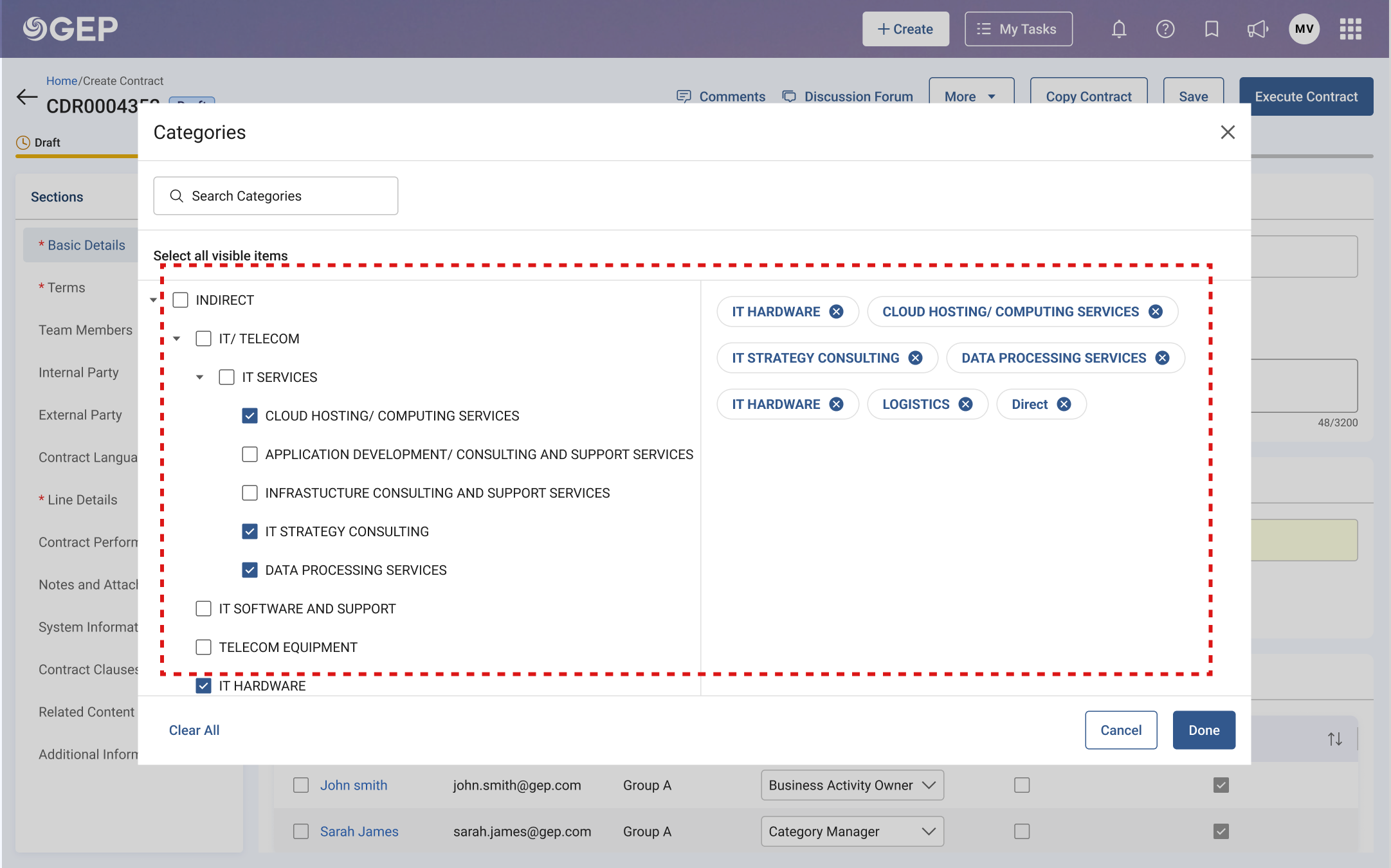
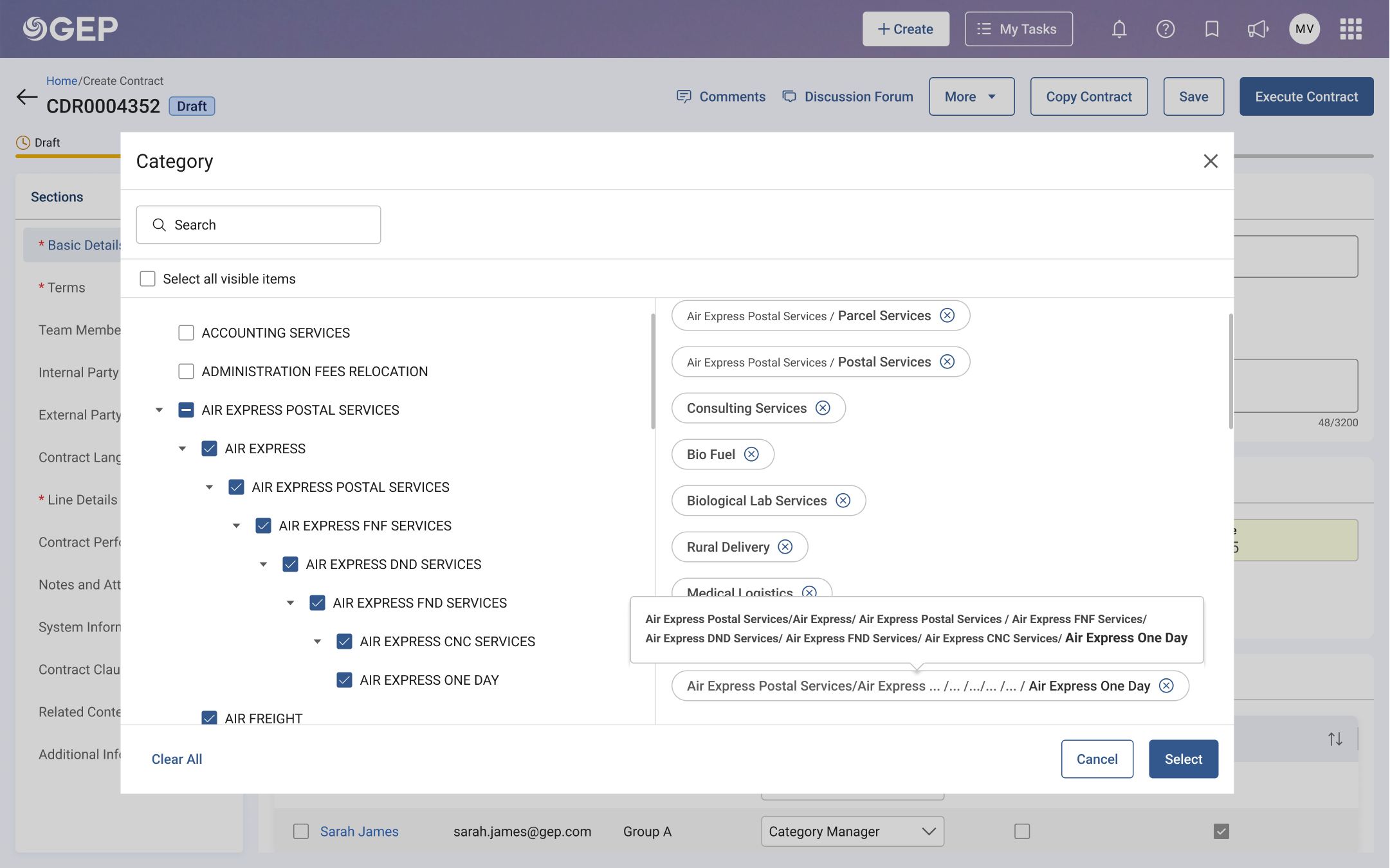
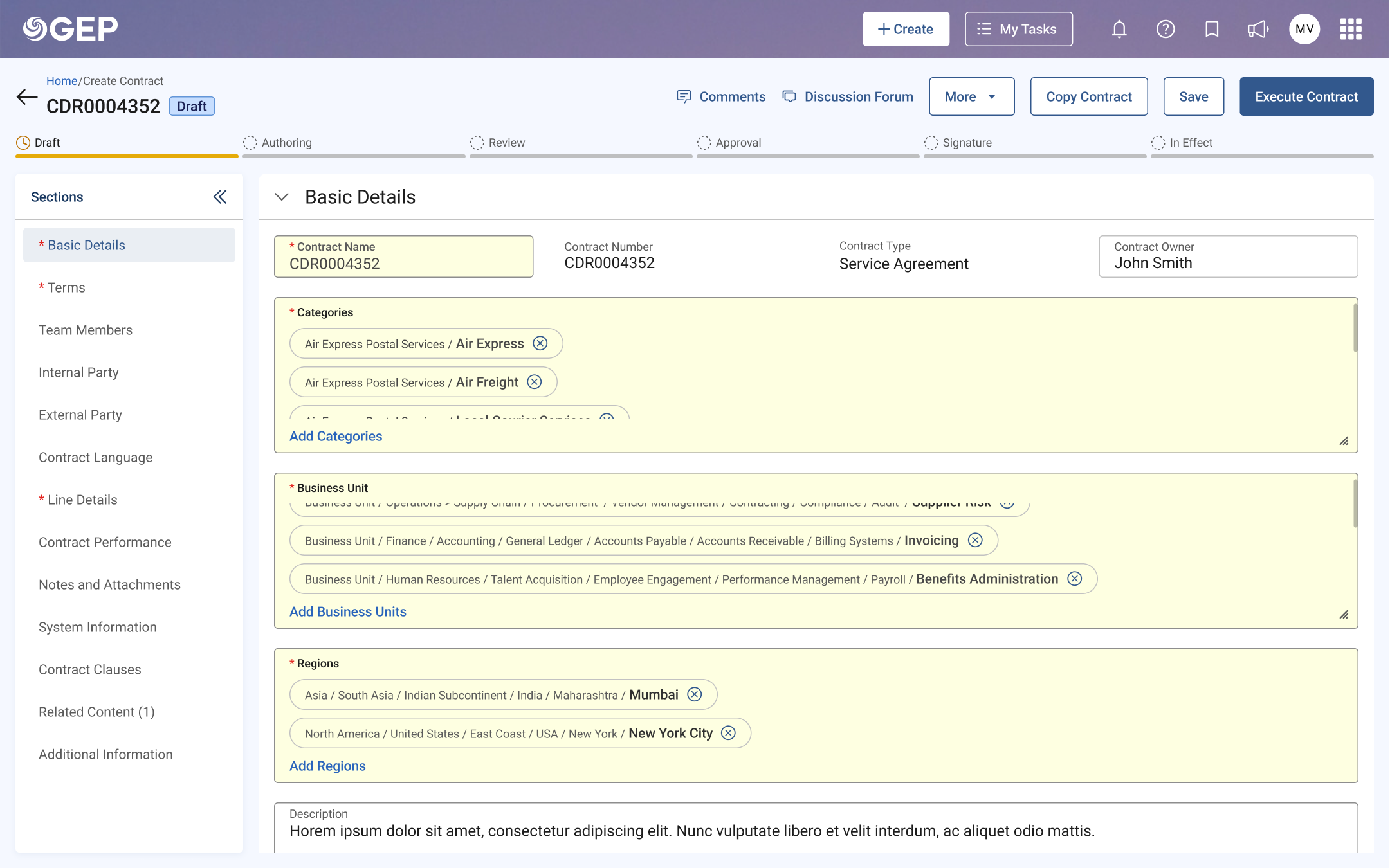
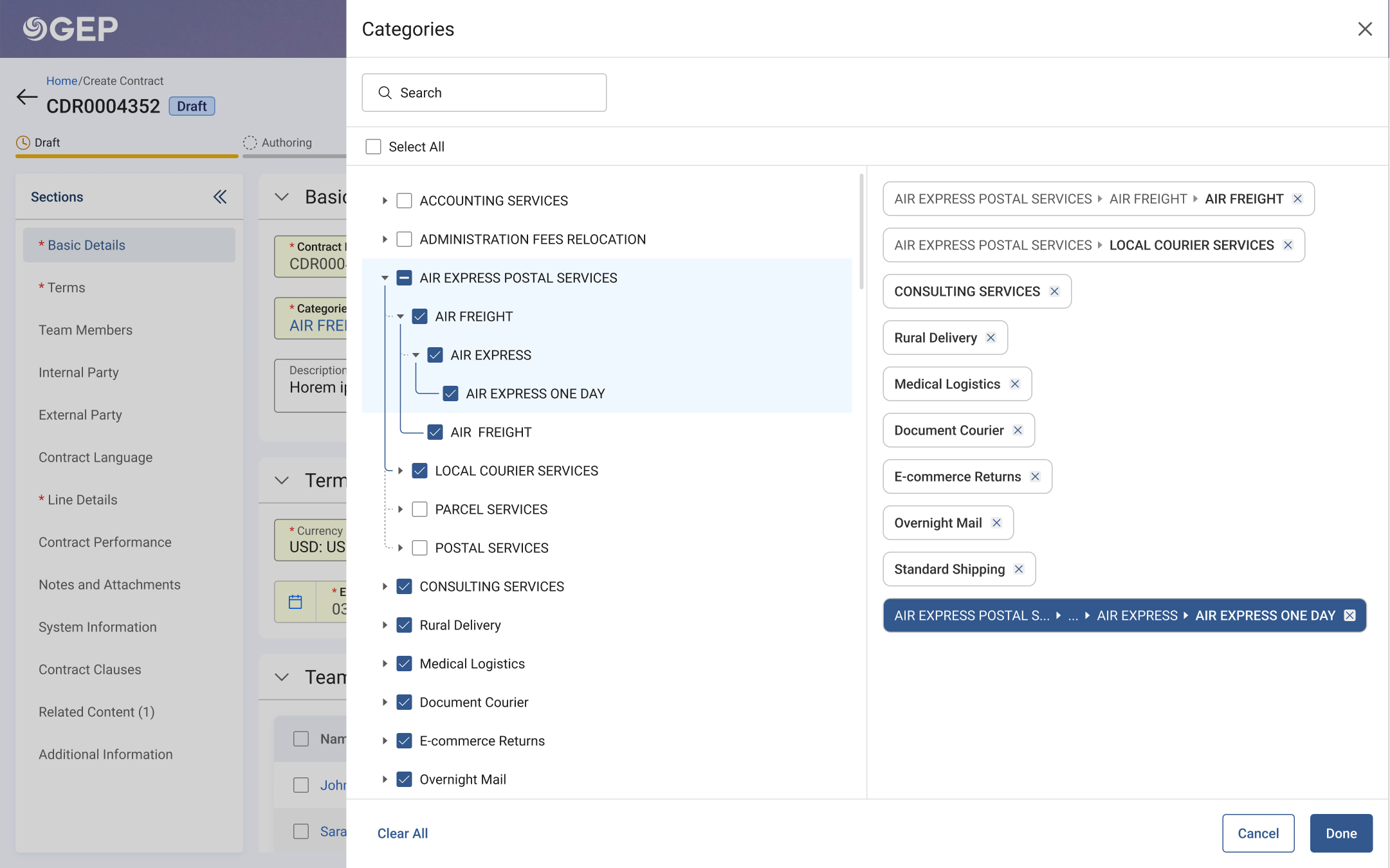
Prototype 1 kept it compact, a slide-out panel with an expandable tree, dotted lines connecting parent to child, and an info icon revealing the full path on hover. Prototype 2 expanded everything inline within the form using chips.
Round 1: A/B testing with Contracts TSOs
6 moderated 1:1 interviews, 30-minute sessions on Teams + FigJam. The research team, Akshita Verma (researcher), Nikhilesh Shetty and I (designers), watched users attempt real tasks.
The verdict was clear
6 out of 6 users preferred Prototype 1. Prototype 2 took too much space and the stretching icon confused users. But Prototype 1 wasn't perfect. The slash separator confused 4 out of 6.
Iteration: Refining for P2P
I replaced slashes with arrow indicators, rethought the tree visualization, and added dotted/solid lines to differentiate hierarchy levels. Then validated with a completely different use-case: Procure-to-Pay.
Round 2: Usability testing with P2P TSOs
Another 6 TSOs, P2P specialists. New team composition: Rupashree joined as co-designer, Akshita continued as researcher. Focused on hierarchy comprehension and search.
What twelve users taught us
usability rating
highlighting useful
Prototype 1
What worked
The i-icon for viewing full hierarchy
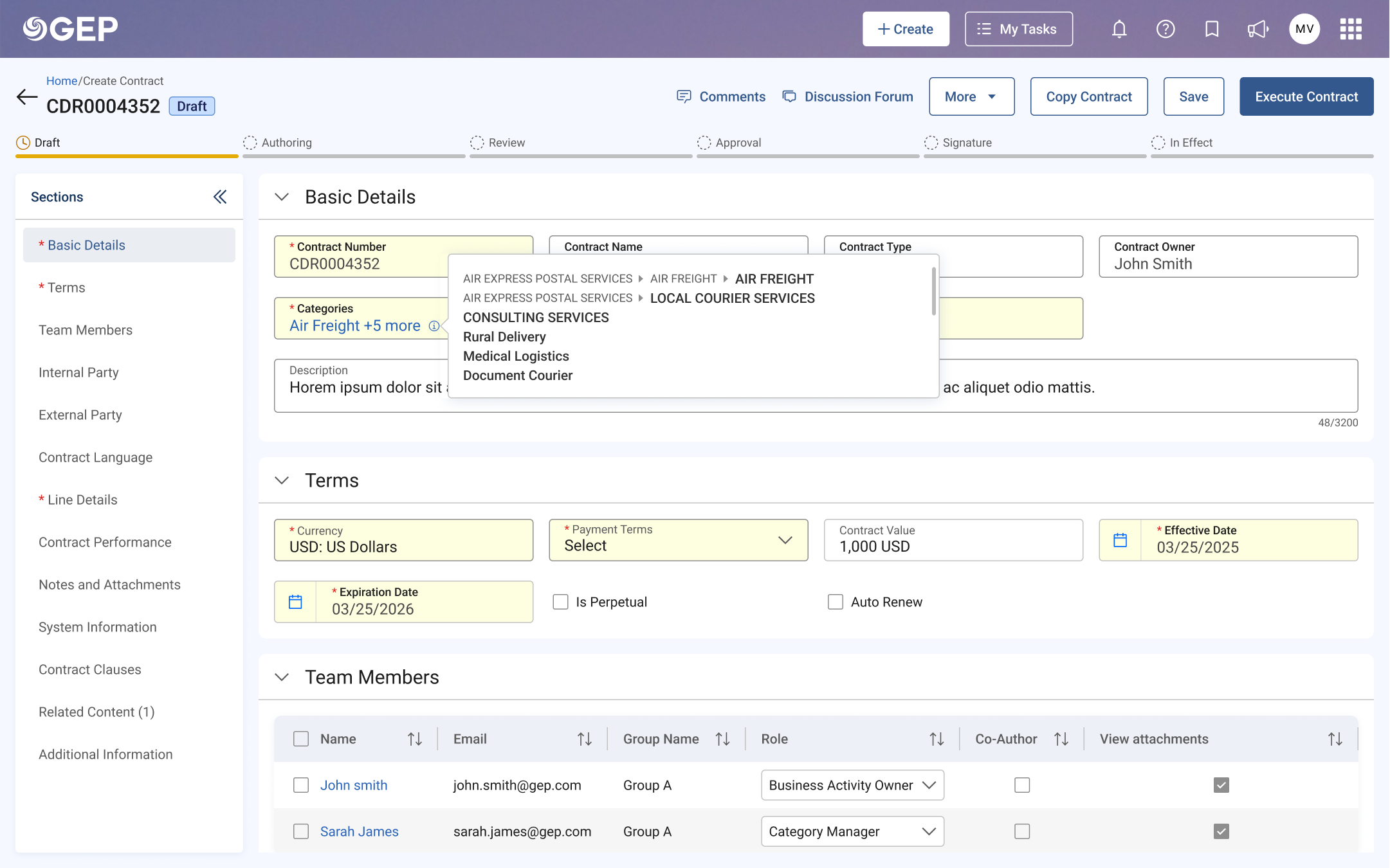
All 12 users found the info icon efficient for seeing the full parent-child path without opening the picker.
Arrow indicators for non-selectable nodes
Scored 4.5/5 in Round 2. Users immediately understood which items were navigational vs. actionable.
Parent-child highlighting on selection
When selecting a child, the entire hierarchy path lit up. All 12 users called this "very useful."
What needed rethinking
Three-dot indicator caused confusion
5 out of 6 users were confused by the three-dot icon. It split preferences: some wanted full tree, others just the child.
Dotted lines had poor visibility
4 out of 6 users found the dotted connector lines too subtle to trace hierarchy relationships at a glance.
Slash separator was unintuitive
4 users preferred arrows or breadcrumb-style indicators that more naturally conveyed parent-to-child relationships.
Showing the tree, not just the fruit
The final design was a slide-out category picker that made hierarchy the hero instead of hiding it. Every design decision tied back to a specific research finding.
The tree structure became the primary view, expanded, clear, with solid connector lines replacing the too-subtle dotted lines flagged in Round 2. Arrow indicators replaced disabled radio buttons on non-selectable parent nodes, making it immediately obvious which items were navigational and which were actionable.
The confusing three-dot indicator was removed entirely, replaced by a breadcrumb-style path display at the top of the panel that showed exactly where you were in the hierarchy at all times.
The info icon tooltip stayed. It was universally loved. Click the small "i" on any input field, and the full parent-to-child path unfolds in a compact tooltip. No need to reopen the picker just to confirm what's been selected.
Search results now showed contextual hierarchy. Find "H11-Installation" and you'd see the full branch path right there in the results.
Designed for the extremes, not just the happy path
Enterprise taxonomy isn't neat. Some clients have 3 levels, others have 6. Category names range from "IT" to 120-character procurement strings. If the design only works for textbook examples, it doesn't work at all.
6-level category tree
Tested with a real CAT structure (Chevron's 4-level + extended 6-level taxonomy) to ensure the tree didn't collapse or become unreadable at depth.
120+ character names
Procurement categories like "Professional Services > IT Infrastructure > Cloud Migration & Modernisation" needed graceful truncation with full-path tooltips.
Single-level flat lists
Not every client uses deep hierarchy. The same component needed to feel natural when the tree was just a flat list of 8 items, no empty-state awkwardness.
Bulk category assignment
Some workflows require assigning multiple categories at once. The selected-state chips and breadcrumb bar had to scale without breaking the panel layout.
Every edge case above was validated in the second round of user testing with TSOs, the people who configure these fields for hundreds of end-users. If it survived their real data, it was ready to ship.
From confusion to confidence
The redesigned CBR (Category, Business Unit, Region) input fields shipped across GEP Quantum's Contracts and P2P modules, the same component now serving users across the platform's most critical workflows.
2 research rounds
Contracts + P2P
across the platform
TSOs who previously had to explain the category structure to end-users verbally could now let the interface do the talking. The hierarchy was visible. The path was traceable. The selections were confident, not guesswork.
What I carried forward
This project taught me that the hardest design problems aren't about making something look better. They're about making invisible structures visible. A five-level taxonomy isn't complicated because of its depth. It's complicated because the interface pretends the depth doesn't exist.
It also reinforced something I now carry into every project: test with the people who configure the system, not just the people who use it. TSOs think about structure differently than end-users, and designing for that difference is what makes enterprise design genuinely challenging and rewarding.
Running two rounds with different user groups pushed me to design for flexibility. The same component had to serve fundamentally different mental models, and that constraint made the final design stronger than either prototype alone.